Combi Stuffed Bear Plush Doll 3 Modes Developmental Baby Mechanical Toys Japan
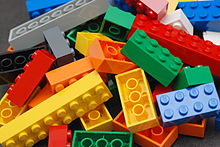
Lego bricks encourage learning through play.
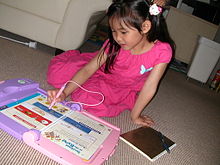
Educational toys (sometimes called "instructive toys")[1] are objects of play, generally designed for children, which are expected to stimulate learning. They are oft intended to meet an educational purpose such as helping a kid develop a particular skill or teaching a child about a particular subject. They oftentimes simplify, miniaturize, or model activities and objects used past adults.
Although children are constantly interacting with and learning well-nigh the earth, many of the objects they collaborate with and learn from are not toys. Toys are by and large considered to exist specifically built for children'due south use. A child might play with and learn from a stone or a stick, but it would not be considered an educational toy considering 1) it is a natural object, not a designed one, and two) information technology has no expected educational purpose.
The difference lies in perception or reality of the toy's intention and value. An educational toy is expected to educate. Information technology is expected to instruct, promote intellectuality, emotional or physical evolution. An educational toy should teach a kid about a detail subject or help a child develop a particular skill. More than toys are designed with the child'south education and development in heed today than always earlier.
History [edit]

Toys accept changed substantially throughout history, as has the concept of childhood itself.[1] In Toys as Culture (1986), anthropologist Brian Sutton Smith discusses the history of toys and states that "in multifarious ways toys are mediating these cultural conflicts within the personal lives of children".[ii] [3] Educational toys in particular tend to reflect the cultural concerns of their fourth dimension.

Inquiry on the history of toys and their utilize tends to focus on western cultures, but work has also been washed on Due north Africa and the Sahara.[4] Puppets or dolls made of wood, clay, wax or cloth may be the earliest known toys. Archaeologists accept found them in sites from Arab republic of egypt, Greece and Rome, and Antonia Fraser emphasizes their universality.[5]
Dolls can be seen as an early "educational toy" because dolls acted equally substitutes, allowing children to larn to intendance for living babies and children. Similarly, toy bows and arrows and other weapons acted every bit substitutes for real weapons, enabling children to develop skills needed for hunting or fighting.[6] [7]
Up until the 20th century, however, manufactured toys were non readily available, and near often were endemic by wealthy families.[8] : 172 Moulded miniature dishes and toy soldiers have been institute in England dating to as early as 1300.[9] : 172–173 There are records of wealthy medieval children owning elaborate toy houses and military toys, which could enable them to mimic adult activities such every bit managing a household or enacting a siege.[9] : 174
Nonetheless, "Nosotros often forget that throughout history, children have happily played without toys and manufactured playthings."[8] : 172 Children improvised a wide variety of toys and games using any came to hand, including fences, barrels, sticks, stones, and sand.[9] : 175–177 Both children and adults played games such as backgammon, dice, chess and cards, which helped to develop transmission dexterity, memory, and strategy.[9] : 178 In 1560, Pieter Bruegel the Elder painted Children's Games. He depicts around 200 children in at least 75 play activities.[nine] : 166 Just a few activities involved toys made specifically for children, and even fewer might be classed as "educational toys": dolls, simple musical instruments and a water gun used to shoot at a bird.[x]
Locke'southward Blocks [edit]

The identification of specific toys equally having an explicitly educational purpose dates to the 1700s.[11] In 1693, in Some Thoughts Concerning Education, liberal philosopher John Locke asserted that educational toys could enhance children's enjoyment of learning their letters: "There may exist dice and play-things, with the letters on them to teach children the alphabet by playing; and twenty other ways may exist found, suitable to their particular tempers, to make this kind of learning a sport to them."[12] This type of block, one of the first explicitly educational toys, is oft identified as "Locke'due south Blocks".[13] [14]
Dissected Maps [edit]

Dissected map of Europe, John Spilsbury, 1766
French educator Jeanne-Marie Le Prince de Beaumont may be the earliest inventor of the jigsaw puzzle or "Dissected Map". Records indicate that she used some type of wooden map to teach girls geography in the 1750s. However, since no examples of her maps still exist, it is incommunicable to confirm that they were "dissected" into pieces. British cartographer John Spilsbury is mostly credited with inventing the jigsaw puzzle or "dissected map" in 1766. He intended it to be an educational tool for geography.[xv] [16]
A Rational Toy-Store [edit]
In Practical Education (1798), Maria Edgeworth and her father Richard Lovell Edgeworth described a "rational toy-shop" where educational toys would be sold. They proposed that such a store should sell materials for a wide variety of activities including carpentry, handicrafts, gardening, chemistry, and natural history.[6] : 13 [17] [18] An important abet for the education of women, Maria Edgeworth'due south ideas virtually science and education were influenced by the philosopher, chemist, and educator Joseph Priestley and the exciting discoveries of the kickoff chemical revolution.[19] Edgeworth even suggested that children be given a play area for loud and messy educational activities, to back up the development of "the young philosopher", who she clearly expected to exist well-to-do.[17]
"To those who learn habits of observation, every thing that is to be seen or heard, becomes a source of amusement... most well ordered families let their horses and their dogs to accept houses to themselves; cannot ane room be allotted to the children of the family unit? If they are to learn chemical science, mineralogy, phytology, or mechanics; if they are to take sufficient actual exercise without tormenting the whole family with noise, a room should exist provided for them.[17]
In dissimilarity to the Edgeworths, Isaac Taylor in Home education (1838) and Charlotte Mary Yonge in Womankind (1876) championed the idea of less structured, more imaginative play.[half dozen] : 13 The range of manufactured toys broadened during the Victorian era but toys connected to exist plush and vest to the wealthy. A toy might cost as much as a working man's wage for a week.[20]
Froebel's Gifts [edit]
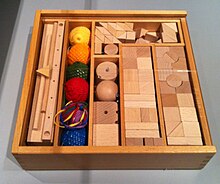
The middle of toy making in the 1800s was Germany, renowned for its fine craftsmanship.[21] Between 1836 and 1850, German educator Friedrich Wilhelm August Fröbel introduced a set of especially shaped geometric solids which he called "gifts" and less solid materials such as foldable papers which he called "occupations". Through interaction with these manipulatives, all five senses were stimulated. They were intended to support learning of concepts such every bit number, size, shape, weight, and cause and effect.[13] [22] : 24 Froebel also established the beginning "Kindergarten".[11] : 49 It provided care and educational activity for pre-school children whose parents were absent-minded at work during the twenty-four hour period.[23] [24]
By 1880, the wooden blocks designed by Froebel had inspired the evolution of Anchor Rock Blocks (German: Anker-Steinbaukasten) made of artificial stone in Deutschland past the Lilienthal brothers. These early structure toy sets have remained in almost continuous product since and then, and mod components are still compatible with the durable antiquarian elements made more than than a century ago.
La Science Amusante [edit]
French engineer Arthur Skillful (under the pen proper noun "Tom Tit") published weekly articles virtually La Scientific discipline Amusante, or Amusing Science in the French magazine 50'Illustration. They were nerveless and published starting in 1889. His geometrical demonstrations, arts and crafts projects, and physics experiments could exist carried out with everyday household materials.[25]
Montessori'southward manipulatives [edit]
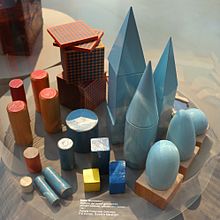
Some of Montessori's many manipulatives
A wide array of manipulatives was introduced in the early 20th century by Maria Montessori. Based on her work in Italy, her book The Montessori method was translated into English language and published in 1912.[26] Montessori's curriculum focused primarily on tactile and perceptual learning in the early years, and was based on developmental theories and work with students. She emphasized practical exercises using prepare-to-manus materials such as pouring rice or tying a shoelace. She likewise developed sets of Montessori sensorial materials, manipulatives for learning mathematics and other skills and concepts. Today, Montessori'due south methods are used in both homes and schools, and her manipulatives have been extensively studied.[27] [28] Her work was strongly motivated past slum conditions and the social and economical disadvantages facing poor women and their children. The Montessori method formed the ground for the creation of educational toys decorated boards.[29]
Construction sets [edit]
During World War I (1914-1918), countries such as U.k. embargoed German appurtenances, including toys. Later, toy-making businesses were established in Britain and other countries, in some cases employing ex-soldiers.[xxx] [31] Britain became a principal supplier of toys, to be followed by America, and later Nippon and China.[32] Toys became cheaper and accessible to more people. However, the emergence of an industrialized toy manufacturing industry in Canada, Britain, and elsewhere was disrupted by the Great Depression.[32] : 148
Meccano, Erector Sets, Tinkertoy, and Lincoln Logs all appeared in the early 20th century, and were promoted as developing fine motor skills, encouraging free play and creativity, and introducing children to applied science and construction ideas.[24]
Frank Hornby of Lancashire, England designed the construction toy Meccano in 1899 to encourage his children's interest in mechanical engineering. Patented as "Mechanics Made Easy" in 1901, information technology became known every bit "Meccano" in 1907. Educators were enlightened of societal changes caused by industrialism, and hoped to interest youngsters in possible new careers.[xxx] [24]
In 1913, A. C. Gilbert introduced the Erector Set with the showtime national advertizing entrada for a toy. The Erector Set contained girders and bolts that could exist assembled into miniature buildings or other structures, and was acclaimed as fostering inventiveness in constructive play. In 1924, information technology was redesigned to include miniature electric motors and other pieces which could be used to create all sorts of self-actuated machines.[33] [24]
Tinkertoy was adult and patented in 1914 by Charles H. Pajeau of Evanston, Illinois. Sets independent interlockable wooden spools and rods that could be combined to make a broad variety of constructions. They were marketed in dissimilar sets, according to the types and numbers of pieces included, assuasive them to be both interoperable and identifiable by difficulty level (e.g. junior, big boy, grad).[34] [24] In addition to utilise as a construction toy, they have been used past scientists and students to model molecules,[24] and even to build a primitive computer.[35]
Lincoln Logs were introduced in 1918 past John Lloyd Wright, second son of the architect Frank Lloyd Wright. They were inspired by structural piece of work for the second Royal Hotel, built in Tokyo, Japan. For the hotel, Frank Lloyd Wright designed a system of interlocking timber beams that were intended protect the hotel against earthquakes by assuasive it to sway without collapsing. His son adjusted the thought to enable children to build constructions that would stand up to rough play. In the 1950s, Lincoln Logs were one of the outset toys to be marketed on television.[36] [24]
Throughout the early part of the 20th century, a diversity of new materials such as plastics were developed, and manufacturing processes became increasingly automated. This supported the development of educational toys, including construction toys, since it enabled the standardization of pieces. Toys such every bit Tinkertoy and Lincoln Logs, which were originally made of wood, were later as well fabricated in plastic versions.[24]
In the mid-1950s, more than explicitly engineering-themed construction toys appeared, including plastic girders, columns, and panels that could be assembled into a model mantle wall skyscraper. Later, this Girder and Panel structural system was extended to a Hydro-Dynamic setup by adding pipes, valves, tanks, nozzles, and pumps to allow construction of model plumbing, HVAC, and chemical technology systems similar a fake distillation column. Other extensions of the system supported suburban-style housing developments (Build-A-Home), or monorail transportation systems (Skyrail).
The building toy Lego was originally developed past Ole Kirk Christiansen in Billund, Denmark, in the 1930s. The proper name Lego is said to be based on the Danish phrase leg godt, or "play well", and is also translatable in Latin as "I study, I put together". By the 1950s, the sets were becoming available across Kingdom of denmark and Germany, eventually being marketed worldwide and surpassing all previous structure toys in popularity. Lego bricks are versatile and are used past adults as well as children to brand a near-limitless diversity of creations.[24] The company has created a line of kits for complex architectural structures such as the Taj Mahal. It has also partnered widely to create theme-based kits for franchises such as Star Wars.[37] [38]
In the late 1960s, Fischertechnik introduced what would eventually become a versatile and powerful gear up of modular construction components, incorporating sophisticated pneumatic, electrical, electronic, and robotic capabilities. The company's products also achieved some success in the hobbyist and school markets, including vocational education programs, merely was overshadowed past Lego in the consumer segment.
External links [edit]
-

Model steam locomotive built with Meccano
-

Pretend Play [edit]
Pretend Play is an imaginative activeness in which "children are playing equally if something or someone is real".[39] "This type of play benefits all areas of a kid's evolution and gives a child tools for experiences after in life such as emotional regulation, inventiveness, and logical reasoning".[twoscore] Pretend play is important for the child's development in many fields, such as: "social and emotional skills, language skills, thinking skills, nurturing the imagination".[41]
Chemistry sets and science kits [edit]
By the 1920s and 1930s, child labor laws and other social reforms were resulting in increased numbers of children attending school. As the amount of time spent at schoolhouse increased, people began to see boyhood as a distinct life stage, with its own "youth culture". With increased urbanization and utilize of cars, there were new options for after-school socialization, some of which were less supervised and allowed for contact across social, class, and gender lines. Teachers and post-depression parents worried that children would become into trouble subsequently school and began to outset after-school clubs. Scientific educational toys were produced and promoted to kids equally fun, and to parents equally keeping kids out of problem and encouraging them to enter well-paying careers in scientific discipline.[42] Chemcraft specifically used the slogan "Experimenter Today . . . Scientist Tomorrow" to marketplace their chemical science sets.[43]
Although portable chemical chests had existed every bit early equally 1791, they were intended for use by adults, rather than children.[44] [43] [45] Porter Chemical Company'southward Chemcraft set up, marketed in 1915, was likely the start chemical science set intended for children. By 1950, Porter sold every bit many as fifteen unlike chemistry sets, ranging widely in price and contents.[43] The A. C. Gilbert Company was another leader, producing toys that promoted a broad diverseness of science activities.[46] Their first chemical science sets appeared in the 1920s, and were followed by many others. Gilbert's biology toys included microscopes (e.k. the Skil Craft Biological science Lab). Other companies produced biological models such as the Visible Frog Anatomy Kit[47] and human anatomical models such as the Visible Man.[48] In 1950, Gilbert fifty-fifty produced a toy targeted at potential physicists, the Gilbert U-238 Atomic Free energy Laboratory, including a cloud sleeping room with a small amount of radioactive textile.[49] During the common cold war, marketing slogans once again reveal social tensions of the time, asserting that "Porter Science Prepares Immature America for World Leadership".[43]
Early on chemistry sets included a wide range of hardware, glassware and chemicals, much of which is omitted from modern-day sets due to later concerns about possible hazards and liability.[50] Modern chemistry kits tend to discourage free-form experimentation, containing a express amount of specific nontoxic substances and a booklet specifying how they can be used for a specific project.[50] Writers often lament that it is no longer possible for chemistry-set users to engage in the wide range of (sometimes chancy) experimentation that attracted them to the field of chemistry as children.[48] [fifty]
Though chemical science sets lost popularity kickoff in the safety-conscious 1960s, they appear to be regaining interest in the 21st century.[44] A line of chemistry sets reminiscent of the traditional Gilbert and Porter sets was marketed as of 2012[update] by Thames & Kosmos.[44] Many modern chemical science sets are designed co-ordinate to the guidelines of microscale chemistry; using precise but smaller quantities of chemicals is more economic and safer than traditional setups. The related genre of forensics science toys has also become popular.[48]
Starting in 1940, Science Service issued a series of Things of Science kits, each focused on a single topic, such as magnetism, seed germination, static electricity, or mechanical linkages. Sold only by monthly mail-order subscription, these kits consisted of a modest blue cardboard box containing basic materials and detailed instructions, unremarkably to be supplemented by commonplace household materials and objects. The wealth of knowledge and entertainment that could be derived from simple and economical materials set a standard which would later be adopted past the pioneering science and technology centre, the Exploratorium in San Francisco.
Marketing of scientific discipline toys has tended to be heavily gendered, with the majority of scientific toy marketing existence directed to boys, with occasional exceptions. A 1921 review of Chemcraft chemistry sets stated that "These outfits are more toys. They are miniature chemical laboratories for boys and girls... this kind of play is most interesting and amusing to every youngster".[51] In 1921, Chemcraft advertised a "Sachetcraft" set for girls that could be used to make perfumes and cosmetics.[52] In the 1950s, Gilbert marketed a pinkish "Laboratory Technician" prepare for girls. It independent a microscope and factory-prepared slides, rather than the raw materials to make one's own slides for viewing.[48] However, the manual independent identical information to that given to boys.[50]
-

Gilbert chemical science gear up, ca.1940
-

A. C. Gilbert Daughter's lab technician set, 1950s
-

Computational toys [edit]
As computers became more prevalent, toys were introduced to expose children to key ideas in digital circuitry and their applications. About of these toys were marketed as educational kits, with modular components that could be combined in various combinations to make interesting and entertaining creations.
A bare-bones computing model was marketed in the form of a bones analog calculator, consisting of three calibrated potentiometers and a low-cost galvanometer arranged in a Wheatstone bridge circuit. This setup allowed unproblematic computations to exist performed, like to a mechanical slide rule, just the accurateness was poor and the components could not be reconfigured in any useful way.
Around 1955, computer scientist Edmund Berkeley designed the computational toy Geniac, and in 1958 a like toy called Brainiac. The rotary switch construction sets used combinational logic but had no retentiveness and could not solve issues using sequential logic. Instruction booklets gave series of instructions for creating complex machines which could solve specific Boolean equations. Specific machines could play uncomplicated games similar tic-tac-toe, or solve arithmetic puzzles, but the output resulted directly from the input given.[53]
In 1961, Scientific Development Corporation introduced the Minivac 601, a simple relay-based electromechanical computer with a primitive retentivity, all designed by the pioneer of data theory, Claude Shannon. The expensive device attracted few buyers, and was soon upgraded and retargeted for the corporate technical training market. In 1963, Eastward.S.R., Inc. marketed the low-cost Digi-Comp I, which allowed children to construct a elementary digital computer, composed entirely of mechanical parts operated by hand. They could and then play with information technology, watching as mechanical versions of "flip-flop" electronic circuits demonstrated Boolean logic computations, solved problems in binary logic, and calculated simple mathematical operations.[fifty]
Past the 1980s, expanding on the popularity of build-your-own radio and electronics kits from Radio Shack and Heathkit, it was possible to buy a kit to build your own ZX-81 microcomputer. Such projects were enthusiastically recommended as a merit badge activity for Boy Scouts.[54] Modern-solar day toys have continued this trend, enabling kids to build their ain circuits, machines, peripherals and computers.[55]
The Lego company expanded into the area of robotics with its Lego Mindstorms kits, introduced in 1998.[24] With the software and hardware provided in the kit, which includes a organisation controller, motors, and peripheral sensors also as ordinary Lego building blocks, children can create programmable robots. Lego Mindstorms draws heavily on the constructionist learning theories of computer scientist and educator Seymour Papert.[56] [57]
More recently, Raspberry Pi is being used by teachers and students. Introduced by Eben Upton and the Raspberry Pi Foundation in the U.k. as an inexpensive pick that would promote educational activity of computer science and programming skills in lower-income schools, it has likewise get pop with makers and engineers.[58]
-

The rudimentary Geniac figurer lacked whatsoever memory (1955)
-

The Minivac 601 featured 6 electromechanical relays and a unique motorized display (1961)
Toy computers [edit]

Uncomplicated computers and game consoles that focused on children's learning started actualization in the 1980s, like this VTech Socrates from 1988.
Some manufacturers regarded standard personal computers as an inappropriate platform for learning software for younger children, and produced custom kid-friendly pieces of hardware instead. The hardware and software are generally combined into a single product, such every bit a laptop-lookalike. Such computers may be custom-designed standalone toys, or personal computers tailored for children'southward use.
Common examples include imaginatively designed handheld game consoles with a variety of pluggable educational game cartridges and book-like electronic devices into which a variety of electronic books tin can be loaded. These products are more portable than full general laptop computers, but accept a much more express range of purposes, concentrating on literacy and numeracy.
Ergonomic hardware is key for baby learning, where tablet computers and touchscreens are preferably used instead of keyboards and calculator mice. Also, a sandbox environment is created, to disable the use of the keyboard (excepting some combination of keys that can merely exist typed past an adult), taskbar, and opening of other programs and screens. Child computer keyboards may utilise large and differently colored keys to help differentiate them. Baby and toddler computers include ABC keyboards.[ citation needed ] Some kid computers include QWERTY keyboards every bit an early on aid in learning typing.[ citation needed ] Pocket-sized mice, about one-half the size of a typical developed mouse, or large trackballs are used in toddler'due south computers. They are programmed for "one-click" functioning.[ commendation needed ] The example may be reinforced to protect information technology from misadventure. Such computers are not seen as a replacement for time spent parenting.[5][ citation needed ]
Educational theories and play [edit]
Sometimes described as "the piece of work of children",[59] child's play tin be viewed equally the procedure through which children feel the earth, practicing and internalizing new skills and ideas. Experiences include imitation, reasoning well-nigh cause and effect, solving issues, and engaging in symbolic thinking."[60] Every bit children grow and acquire, the repertoire of skills which they are developmentally ready to learn expands, building upon previous knowledge. Play is important for children'southward cognitive, emotional, and social development.[60] [61]
Teachers who utilise educational toys in classroom settings endeavour to identify toys that will be appropriate to a child's developmental level, existing skills, and interests. They try to engage children with toys in ways that back up cognitive development.[sixty] Many educators emphasize the importance of open-concluded imaginative play, exploration and social engagement. Toys with the quality of open-endedness can be used by children in a variety of ways and at different ages and developmental levels.[62] Educational toys vary widely in terms of their open-endedness and their potential for exploration, imaginative play, and social engagement.[63] : 92–93 Play theorist Brian Sutton Smith, who advocates for complimentary play, has asserted that "the plans of the playful imagination dominate the objects or the toys, non the other manner around."[8] : 65 Toys whose design is more heavily specified and restricted may be less intuitive for children to employ, and require more engagement and back up from adults. Many studies of educational toys study that the effectiveness of a toy is more related to the interest and guidance of adults, or to the child's intellectual level, than to the toy itself.[11] : 53
Educational toys claim to enhance intellectual, social, emotional, and/or physical development. Educational toys are thus designed to target development milestones within advisable age groups. For preschool age youngsters, unproblematic wooden blocks might be a expert starting point for a child to begin to empathize causal relationships, bones principles of science (eastward.g. if a block falls from the acme of a structure, information technology volition fall until a surface stops its autumn), and develop patience and rudimentary manus-eye coordination. For a child moving towards simple schoolhouse, other, more sophisticated manipulatives might further aid the development of these skills. Interlocking manipulative toys like Lego or puzzles challenge the child to amend hand-middle coordination, patience, and an agreement of spatial relationships. Finally, a kid in elementary schoolhouse might utilise very sophisticated structure sets that include moving parts, motors and others to help further understand the complex workings of the world. Importantly, the educational value derived past the child increases when the educational toy is age appropriate.[sixty]
Measuring educational effectiveness [edit]
Studies that examine the usefulness of manipulatives have found that outcomes may vary widely depending on concrete characteristics of the materials themselves and the ways in which they are used. Emphasis is often placed on the importance of the physicality of the manipulative, only some piece of work on teaching geometry concepts suggests that manipulability and meaningfulness are more than important than physicality. Students who used a Logo computer program that required them to consider their actions carefully learned more than students who learned from textbooks, and retained that knowledge longer than students who used physical manipulatives.[64]
Marketing [edit]
Toys are big business organisation: the global toy market is estimated at over eighty billion The states dollars annually. In 2013 the average household in the United Kingdom spent the equivalent of $438 U.s. per kid on toys, while US families spent $336 per child.[65] In advertizement, "educational toys" are sometimes differentiated from "promotional" toys, which are marketed primarily as office of a group of related products (eastward.g. American Daughter dolls, Transformers, Steven Universe toys).[63] : 86–89 It is also possible for these categories to overlap (due east.g. Star Wars Legos).
The term "educational toy" is often practical in toy ad to promote sales to parents.[63] : 92–93 The packaging of many toys includes a table of skills and benefits asserted to be enhanced past apply of the production. The bodily developmental benefit of these, past comparison to a cheaper, simpler or more than easily available production, is often unproven. In many cases homemade educational toys may be but as effective equally expensive purchased ones, as long as developmental issues are understood.[sixty]
Examples [edit]

Didactic model of anatomical planes
Examples of educational toys include:
- Building toys, such as toy blocks
- Automoblox wooden construction cars
- Scale models
- Chemistry sets
- Construction toys
- Erector Ready
- Lego
- Meccano
- Electronic toys
- Speak & Spell, Speak & Read, and Speak & Math
- VideoSmarts and ComputerSmarts
- Many VTech and LeapFrog products
- Microscopes
- Skil Craft Biology Lab, 1960s[47]
- Models of real objects
- Model aircraft
- Model railroads
- Model cars and other vehicles
- Model animals, e.g. Carnegie collection
- Model microbes, e.1000. GIANTmicrobes
- Playmobil model scenes
- Musical instruments
- Toy pianoforte
- Physics
- Euler'southward Deejay
- Galilean cannon
- Rattleback
- Tippe top
- Fidget Spinners
- Robot and Robot kits
- two-XL and Kasey the Kinderbot
- Botley the Coding Robot
- Lego Mindstorms
- qfix robot kit
- Puzzles
- Learning tools
- Tutor Systems
- Science kits
- Science Kit and Boreal Laboratories
- Thames & Kosmos
- Flintobox
See too [edit]
- Constructionism (learning theory)
- Education
- Educational game
- Educational software
- Parenting styles
- Puzzle
- Toy advertizement
- Educational entertainment
References [edit]
- ^ a b Jaffé, Deborah (2006). The history of toys : from spinning tops to robots . Stroud: Sutton. ISBN9780750938495.
- ^ Mechling, Jay (1987). "Reviewed Work: Toys equally Culture by Brian Sutton-Smith". The Journal of American Folklore. 100 (397): 350–352. doi:ten.2307/540344. JSTOR 540344.
- ^ Sutton Smith, Brian (1986). Toys as culture. New York, N.Y.: Gardner Press. ISBN9780898761054.
- ^ Rossie, Jean-Pierre (2005). Toys, play, culture and lodge : an anthropological approach with reference to North Africa and the Sahara. Stockholm: SITREC. ISBN978-91-974811-3-seven . Retrieved 23 January 2017.
- ^ Fraser, Antonia (1973). Dolls . London: Octopus Books. ISBN978-0706400564.
- ^ a b c Kuznets, Lois Rostow (1994). When toys come alive : narratives of blitheness, metamorphosis, and development . New Oasis: Yale University Press. pp. 10–. ISBN978-0300056457 . Retrieved 23 January 2017.
- ^ Dawe, Bob (1997). "Tiny Arrowheads: Toys in the Toolkit". Plains Anthropologist. 42 (161): 303–318. doi:ten.1080/2052546.1997.11931825. JSTOR 25669485.
- ^ a b c Kline, Stephen (1995). "Chapter 8: The promotion and marketing of toys: time to rethink the paradox?". In Pellegrini, Anthony D. (ed.). The time to come of play theory : a multidisciplinary inquiry into the contributions of Brian Sutton-Smith. Albany: State Univ. of New York Press. p. 165. ISBN978-0-7914-2641-8.
- ^ a b c d e Orme, Nicholas (2003). Medieval children (1st ed.). New Haven, Conn.: Yale Univ. Press. ISBN9780300097542 . Retrieved 23 January 2017.
- ^ "Pieter Bruegel the Elder's "Children'due south Games" (Painting)," in Children and Youth in History, Item #332, accessed January 23, 2017. Annotated by Miriam Forman-Brunell.
- ^ a b c Goldstein, Jeffrey H. (1994). Toys, play, and child evolution (1st ed.). New York: Cambridge University Press. pp. 46–. ISBN978-0521455640 . Retrieved 23 January 2017.
- ^ Locke, John (1909–1914). Some Thoughts Apropos Education. The Harvard Classics. Retrieved 23 January 2017.
- ^ a b "Milestones in the History of Blocks as a Learning Tool". National Association for the Teaching of Young Children . Retrieved 23 Jan 2017.
- ^ "Alphabet Blocks". The Strong National Hall Toy of Fame . Retrieved 23 January 2017.
- ^ McAlhany, Joe. "A Brief History of Dissected Maps, the Earliest Jigsaw Puzzles" (PDF). Old World Auctions . Retrieved 24 January 2017.
- ^ "The Fourth dimension of the Jigsaws". BBC. 15 November 2016.
- ^ a b c Edgeworth, Maria (1798). "1". Applied Education. Vol. I.
- ^ Edgeworth, Maria; Edgeworth, Richard Lovell (1825). Works of Maria Edgeworth: Modern Griselda. Moral tales. Boston: South. H. Parker. pp. 305–308. Retrieved 23 January 2017.
- ^ Bruck, M. T. (1996). "Maria Edgeworth; Scientific 'LITERARY Lady'". Irish gaelic Astronomical Periodical. 23 (1): 49–54. Bibcode:1996IrAJ...23...49B.
- ^ "Victorian Toys and Victorian Games". Victorian Children . Retrieved 24 January 2017.
- ^ "Popular Toys in History: What Your Ancestors Played With". Beginnings . Retrieved 24 January 2017.
- ^ Helgoe, Catherine A. (2008). The Bear upon of Federal Policy on Teachers' Employ of Science Manipulatives: A Survey of Teacher Philosophy and Practices Volume. Pepperdine University. pp. 24–. ISBN9780549456254 . Retrieved 23 Jan 2017.
- ^ Samuel Lorenzo Knapp (1843), Female biography; containing notices of distinguished women, in different nations and ages. Philadelphia: Thomas Wardle. p. 230.
- ^ a b c d e f k h i j Cole, David J.; Cole, Eve Browning; Schroeder, Fred E.H. (2003). The encyclopedia of everyday inventions. Westport, Conn.: Greenwood Press. pp. 73–77. ISBN978-0313313455 . Retrieved 25 Jan 2017.
- ^ Edelman, Eric. "The Collaged World of Tom Tit". RetroCollage . Retrieved 11 December 2012.
- ^ Montessori, Maria; George, Anne Everett (1912). The Montessori Method. New York: Frederick A. Stokes Visitor. Retrieved 23 January 2017.
- ^ Laski, Elida 5.; Jor'dan, Jamilah R.; Daoust, Carolyn; Murray, Angela Grand. (June 25, 2015). "What Makes Mathematics Manipulatives Effective? Lessons From Cerebral Scientific discipline and Montessori Education" (PDF). SAGE Open up. 5 (ii): 215824401558958. doi:10.1177/2158244015589588. S2CID 11722953.
- ^ Havis, Elizabeth G. Hainstock ; foreword past Lee (1997). Teaching Montessori in the home : the pre-school years (New updated ed.). New York: Plume. ISBN978-0452279094.
- ^ "Early on History of Montessori". American Montessori Society . Retrieved 24 January 2017.
- ^ a b "Must Have Toys 1900-1919". 5&A Museum of Childhood Bethnal Green, London . Retrieved 24 Jan 2017.
- ^ "Schools Globe State of war I". What did children do for fun?. BBC. Retrieved 24 January 2017.
- ^ a b Hutchinson, Braden P.L. (2013). OBJECTS OF Affection: PRODUCING AND CONSUMING TOYS AND Childhood IN CANADA, 1840 - 1989. Kingston, Ontario: Queen's University. p. 23. Retrieved 24 January 2017.
- ^ "Erector Set". The Stiff National Hall Toy of Fame . Retrieved 23 January 2017.
- ^ Coopee, Todd. "Tinkertoys Vintage Toys". Toy Tales . Retrieved fourteen March 2016.
- ^ "Original Tinkertoy Estimator | X39.81 | Computer History Museum". www.computerhistory.org . Retrieved 2017-01-27 .
- ^ Klein, Christopher (February 12, 2016). "The Nativity of Lincoln Logs". History in the Headlines.
- ^ Tillotson, Giles (2008). Taj Mahal. Cambridge, Mass.: Harvard University Press. p. 174. ISBN9780674066281 . Retrieved 25 Jan 2017.
- ^ Maciorowski, Ed; Maciorowski, Jeff (Nov xvi, 2015). The Ultimate Guide to Collectible Lego Sets. F+W Media, Inc. p. 112. ISBN9781440244827 . Retrieved 25 January 2017.
- ^ "What is Pretend Play?" (PDF).
- ^ "Is Pretend Play Good for Kids?". Psychology Today . Retrieved 2018-02-13 .
- ^ "The Importance of Pretend Play". Scholastic.com . Retrieved 2018-02-13 .
- ^ Drupe Drago, Elisabeth (2016). "Rebel without a Chemical science Set". Distillations. two (1). Retrieved 23 March 2018.
- ^ a b c d Cook, Rosie (2010). "Chemistry at Play". Chemic Heritage Magazine. 28 (i): 20–25. Retrieved 23 March 2018.
- ^ a b c Zielinski, Sarah (October 10, 2012). "The Ascent and Autumn and Rise of the Chemistry Ready". Smithsonian Magazine . Retrieved 25 Jan 2017.
- ^ Jensen, William B. "3. 3 Centuries of the Chemical science Set Part II: The 20th Century" (PDF). University of Cincinnati Section of Chemical science . Retrieved 27 January 2017.
- ^ "My Experience with Gilbert Science Sets". Jitterbuzz.com . Retrieved 25 January 2017.
- ^ a b Drupe Drago, Elisabeth (2016). "It's Live! A 1960s toy that revealed a subconscious world". Distillations. 2 (1): seven. Retrieved 23 March 2018.
- ^ a b c d Hix, Lisa (July 20, 2011). "Cyanide, Uranium, and Ammonium Nitrate: When Kids Really Had Fun With Science". Collector's Weekly . Retrieved 25 January 2017.
- ^ Berry Drago, Elisabeth (2016). "Hazardous Fun". Distillations. two (2): eight–ix. Retrieved 23 March 2018.
- ^ a b c d e Sullivan, Jim (Oct 30, 2014). "The five Retro Scientific discipline Kits That Inspired a Generation of Tinkerers". Discover Mag . Retrieved 25 Jan 2017.
- ^ "Educational Toys in Demand by Present-Mean solar day Youngsters". Bookseller and Stationer. 54: 191. March 1, 1921. Retrieved 25 January 2017.
- ^ "Chemcraft (Advert)". Boys' Life. Dec 1921. p. 36. Retrieved 27 January 2017.
- ^ "Geniac". Early Computers Project. Retrieved June 14, 2013.
- ^ Perry, Robert L. (October 1982). "Electronics kits for merit badges". Boys' Life. p. xix. Retrieved 26 January 2017.
- ^ Pullen, John Patrick (Oct 13, 2015). "These v Kits Can Teach Kids About Computers and Coding". Fourth dimension . Retrieved 26 Jan 2017.
- ^ Blikstein, Paulo. "Seymour Papert's Legacy: Thinking About Learning, and Learning Almost Thinking". Transformative Learning Technologies Lab . Retrieved 26 Jan 2017.
- ^ Papert, Seymour (2009). Mindstorms the consummate guide for families living with traumatic encephalon injury. Cambridge, Mass.: Da Capo Press.
- ^ Cunningham, Jason (2013). "Tech in the Classroom: Raspberry Pi". Educational activity Globe.
- ^ Paley, Vivian Gussin (2004). A child's work: the importance of fantasy play. Chicago: Academy of Chicago Press. ISBN9780226644981.
- ^ a b c d e Guyton, Gabriel (2011). "Using Toys to Support Infant-Toddler Learning and Development" (PDF). Young Children. September: 50–56. Retrieved twenty Jan 2017.
- ^ Farenga, Stephen J.; Ness, Daniel (2005). Encyclopedia of education and human development. Armonk, N.Y.: M.E. Sharpe. pp. 163–164. ISBN9780765612687 . Retrieved 20 January 2017.
- ^ Casper, Virginia; Theilheimer, Rachel (2010). "Chapter 4: Children Agreement the Earth through Play". Early childhood teaching : learning together (1st ed.). New York: McGraw-Loma College Educational activity. pp. 95–125. ISBN9780073378480.
- ^ a b c Soto, Lourdes Diaz (1999). The politics of early childhood education. New York: P. Lang. pp. 86–89, 92–93. ISBN9780820441641.
- ^ Viadero, Debra (Apr 24, 2007). "Studies Find That Use of Learning Toys Can Backfire Though some children helped, others distracted by in-class 'manipulatives'" (PDF). Education Week. 26 (34): 12–13. Archived from the original (PDF) on February ii, 2017.
- ^ "Average corporeality spent per child on toys by land in 2013 (in US dollars)". The Statistics Portal . Retrieved 20 Jan 2017.
Source: https://en.wikipedia.org/wiki/Educational_toy
0 Response to "Combi Stuffed Bear Plush Doll 3 Modes Developmental Baby Mechanical Toys Japan"
Post a Comment